1. Problem
Transformer models achieve strong performance but are extremely inefficient for long sequences and deep architectures. In practice, they suffer from three fundamental bottlenecks:
- Activation memory scales linearly with the number of layers, because activations must be stored for backpropagation;
- Feed-forward layers consume large memory, since the intermediate dimension $d_{ff}$ is much larger than the model dimension;
- Self-attention has quadratic time and memory complexity $O(L^2)$ in sequence length, making long sequences (e.g., 64K tokens) impractical even with memory-efficient implementations.
As a result, large Transformers often cannot be trained or even fine-tuned on a single accelerator, limiting scalability and accessibility. The key question posed by the paper is whether this limitation is fundamental—or merely due to architectural inefficiency.
2. Method
Reformer addresses these inefficiencies by redesigning the Transformer with three complementary techniques:
2.1. Locality-Sensitive Hashing (LSH) Attention
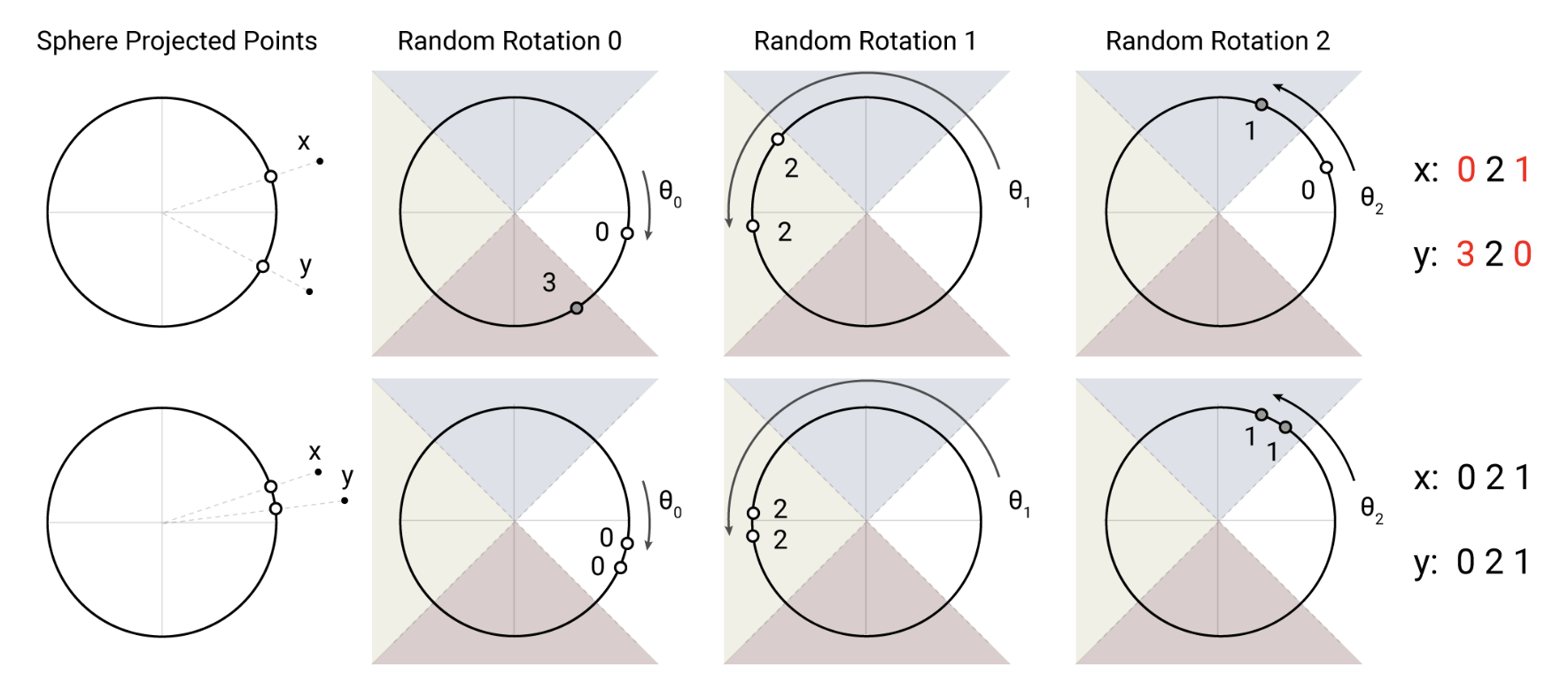
Full dot-product attention is replaced with an approximate attention mechanism based on angular locality-sensitive hashing. Queries and keys are shared $(Q=K)$ and hashed so that only nearby tokens (in embedding space) attend to each other. This reduces attention complexity from $O(L^2)$ to $O(L \log L)$ while preserving accuracy through multiple hashing rounds.
2.2. Reversible Residual Layers
Standard residual connections are replaced with reversible layers, allowing activations from earlier layers to be reconstructed during backpropagation instead of stored. This removes the linear dependence on the number of layers in activation memory.
2.3. Chunked Feed-Forward Computation
Feed-forward layers are computed in chunks over the sequence dimension, exploiting position-wise independence. This avoids storing large intermediate activations of size $d_{ff}$, further reducing peak memory usage.
Takeaway
Together, these changes produce the Reformer architecture, which matches standard Transformer performance while enabling efficient training on very long sequences and deep models with dramatically lower memory requirements.