Problem
Modern Transformers are powerful but fundamentally opaque. Even with mechanistic interpretability tools (attention analysis, circuit discovery), understanding what algorithm a trained Transformer implements still requires heavy manual effort and is often incomplete or misleading.
Previous work like RASP and Tracr shows that human-written programs can be compiled into Transformers, but not the reverse: we cannot take an arbitrary trained Transformer and reliably recover a faithful, human-readable program.
Core problem:
This paper targets intrinsic interpretability, not explanation after the fact.
Method
The authors propose Transformer Programs:
The method has three key ideas:
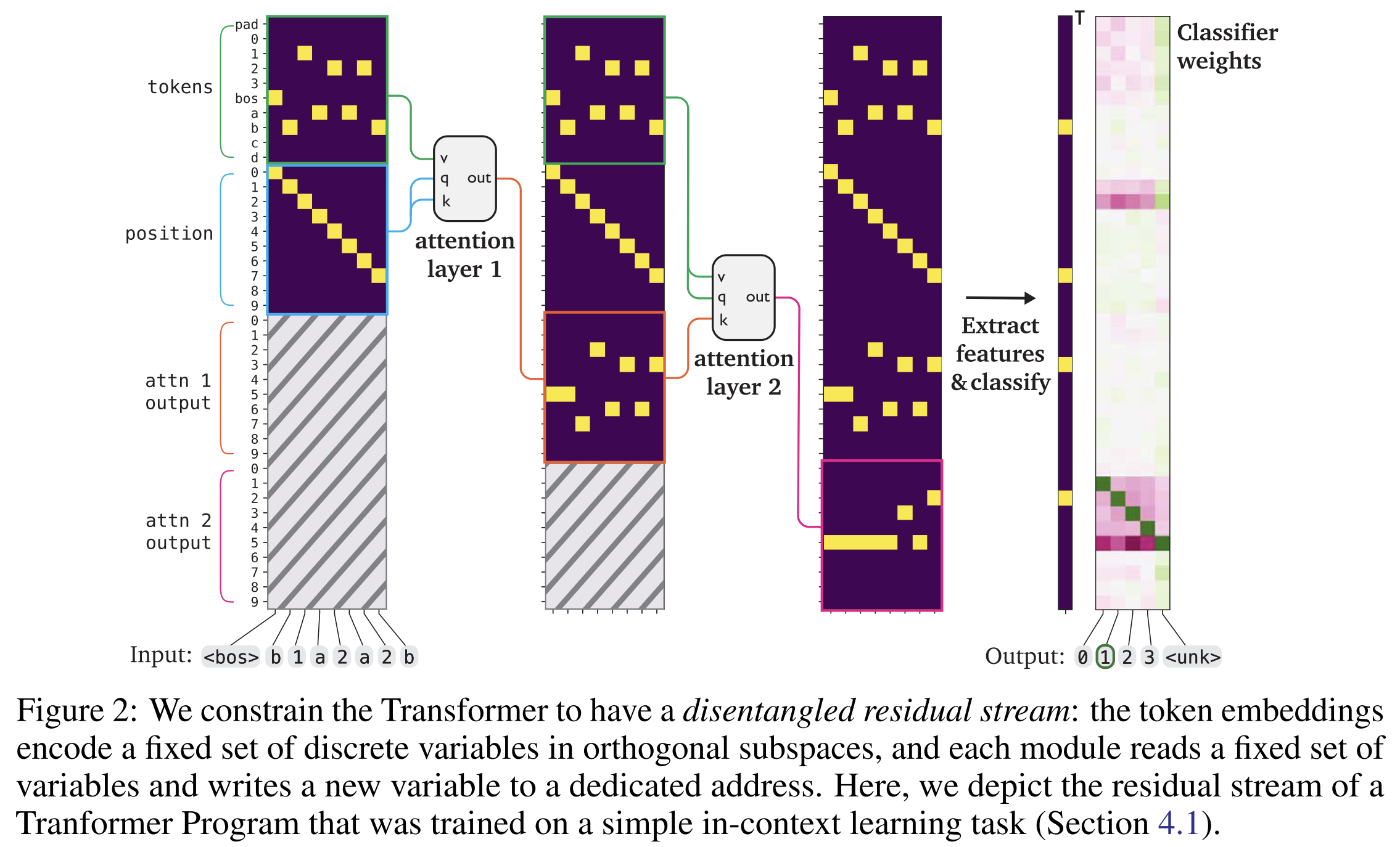
1. Disentangled Residual Stream (Program Variables)
- The residual stream is split into named, orthogonal variables (e.g.
tokens,positions,attn_1_output, …). - Each attention head reads specific variables (V) and writes a new variable to a fresh slot.
- This mirrors RASP’s shared tape, but implemented as structured residual slots.
2. Interpretable Attention = select + aggregate
- Each attention head is constrained to implement:
- a discrete predicate (
which query attends to which key) - followed by hard attention (attend to exactly one key).
- a discrete predicate (
- Attention predicates are parameterized as categorical choices, learned with Gumbel-Softmax, then discretized.
- This makes every head equivalent to a RASP
selectoperator, with aggregation matchingaggregate.
3. Discrete Optimization → Program Extraction
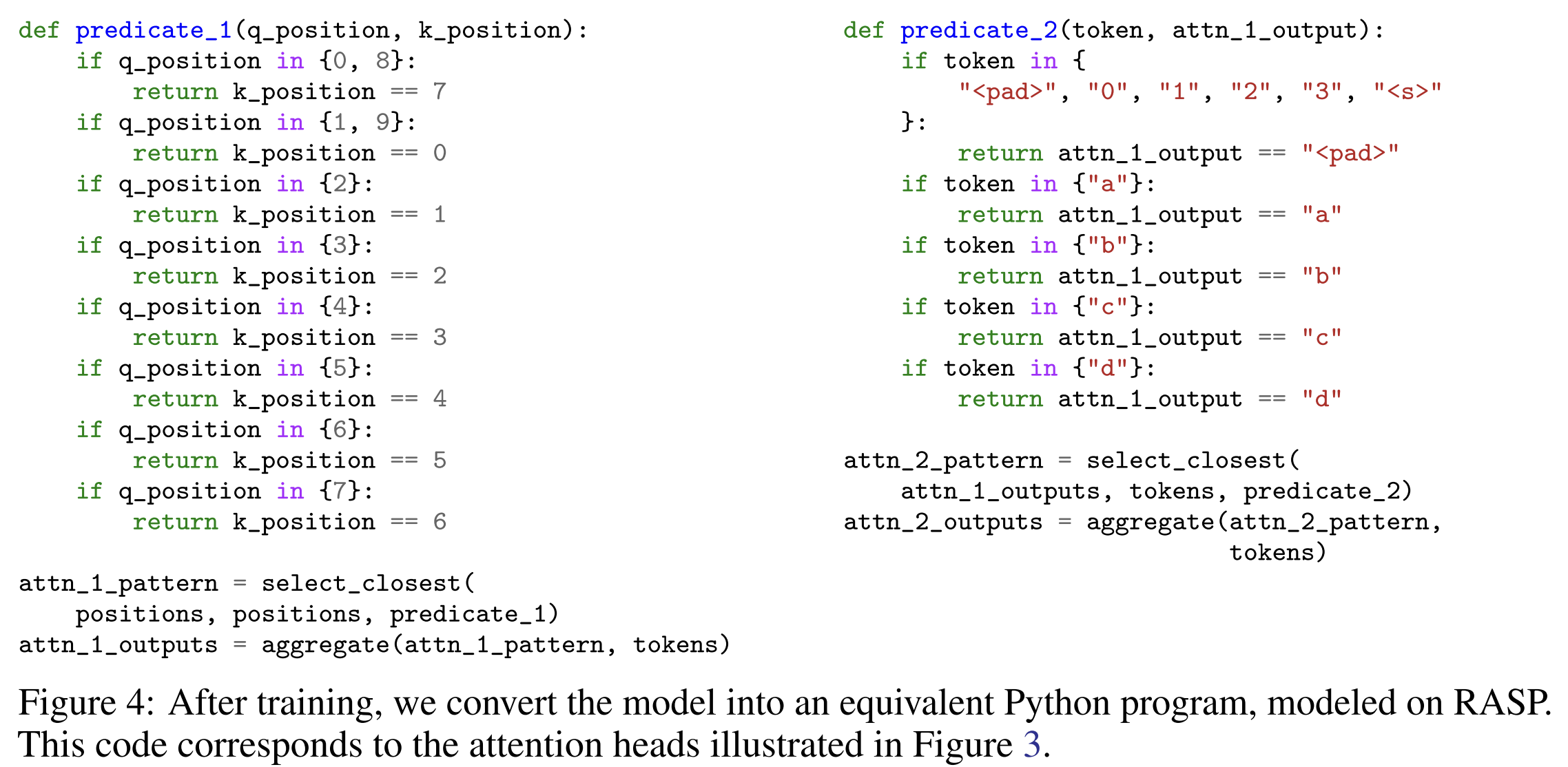
Training is done with continuous relaxations of discrete choices. After training, the model is fully discretized:
- predicates become
if/elserules, - attention becomes symbolic selection,
- MLPs become lookup tables.
The entire model is then automatically converted into Python code, functionally identical to the Transformer and debuggable with standard tools.
Extensions
- Numerical attention for counting (RASP
selector_width) - Constrained MLPs as finite lookup tables
- Learned word embeddings decomposed into categorical variables
One-sentence takeaway
Instead of explaining black-box Transformers, this paper trains Transformers that can be directly converted into programs, so interpretation becomes reading code—not guessing behavior.