This paper introduces BANANAS (Bayesian Optimization with Neural Architectures for Neural Architecture Search), a framework designed to automate the design of neural network architectures.
The researchers identified five core components of the “Bayesian Optimization (BO) + neural predictor” framework and conducted an extensive ablation study to determine the most effective configurations.
You could find the ins and outs of the paper in the presentation slides: BANANAS.pptx
Core Framework Components
The authors broke down the BO + neural predictor framework into five distinct modules, testing various methods for each to find the optimal combination:
| Component | Definition | Top-Performing Choice(s) |
|---|---|---|
| Architecture Encoding | How a graph-based architecture is represented as a vector for the model. | Path Encoding (Novel contribution). |
| Neural Predictor | The model that predicts the accuracy of unseen architectures. | Feedforward (MLP) or GCN. |
| Uncertainty Calibration | How the model estimates its own “confidence” in a prediction. | Ensemble of neural predictors (size 5). |
| Acquisition Function | The strategy used to balance exploring new designs vs. exploiting known good ones. | Independent Thompson Sampling (ITS). |
| Acquisition Function Optimization | The method used to find the next best architecture to test. | Mutation (randomly changing one edge/node). |
The BANANAS Algorithm
By combining the best components from their analysis, the authors created the BANANAS algorithm. It operates three steps:
- Initial Sampling: Start by training a small set of random architectures.
- Iterative Search includes:
- Train an ensemble of MLPs using path encoding on all evaluated architectures.
- Generate candidate architectures by mutating the best-performing ones found so far.
- Use Independent Thompson Sampling to select the most promising candidates.
- Parallelization: The algorithm can output $k$ architectures at once to be trained in parallel, reducing total search time.
Experimental
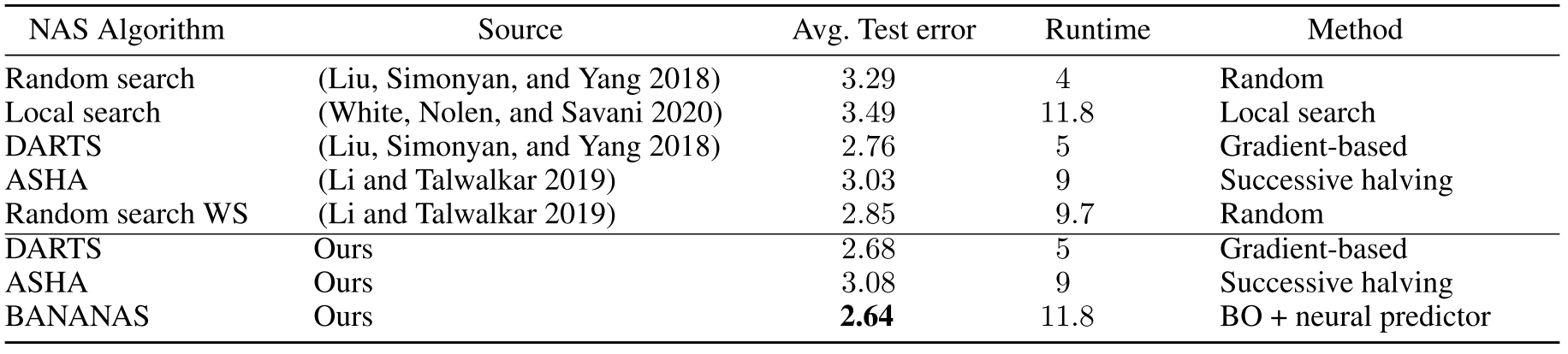
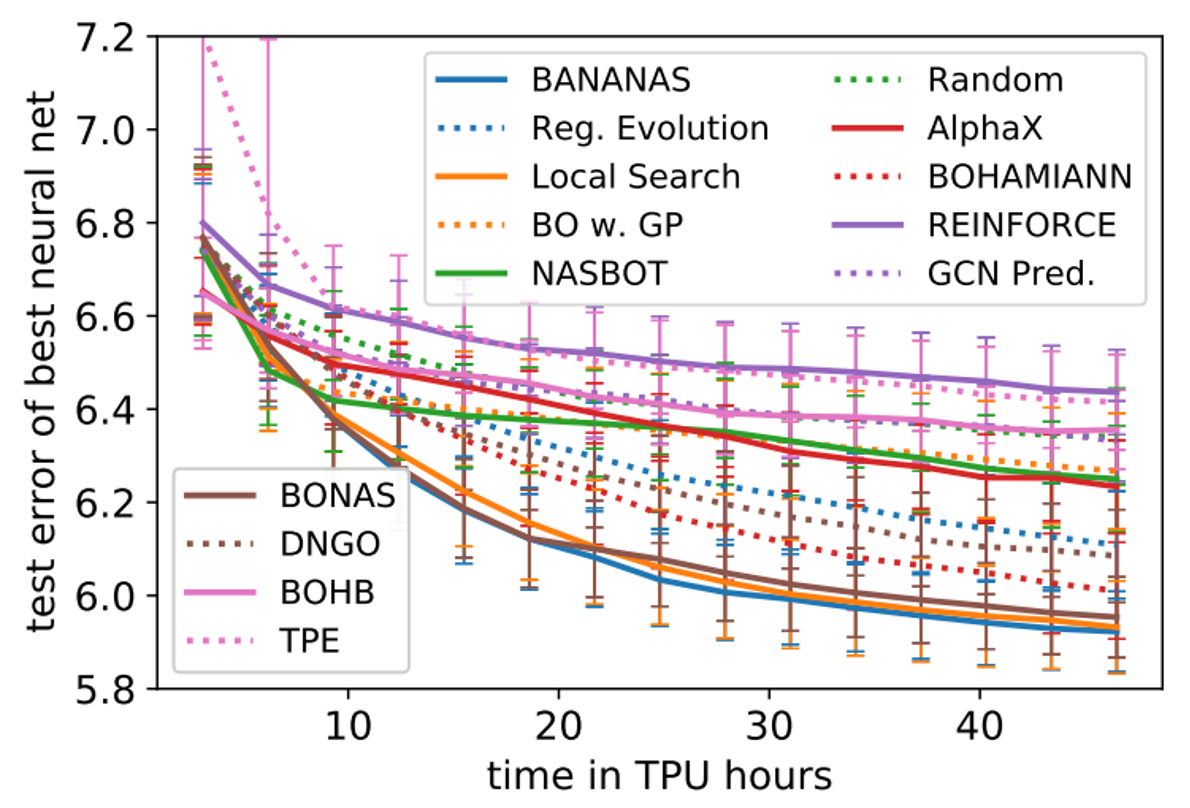
BANANAS demonstrated state-of-the-art (SOTA) performance across several major NAS benchmarks, NASBench-101, NASBench-102 and DARTS.
NASBench-101: Achieved SOTA performance, outperforming methods like Regularized Evolution and various GP-based BO approaches.
DARTS Search Space: Achieved a mean test error of 2.64% on CIFAR-10, making it competitive with gradient-based methods like DARTS (2.68%) but within a more flexible BO framework.